


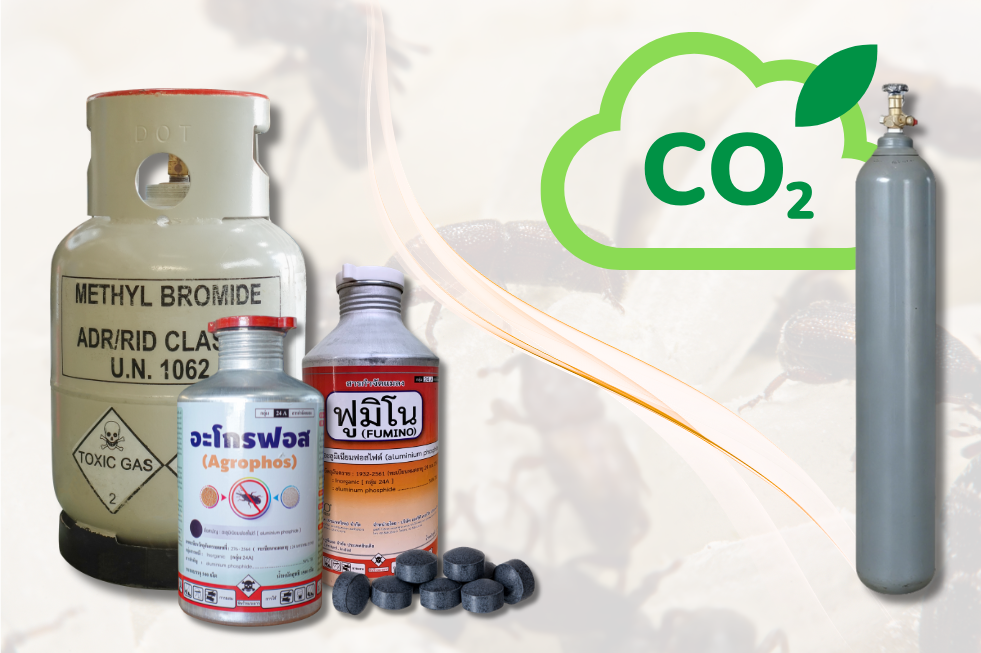
Controlling stored-product insects and pests in agricultural commodities, dried foods, and wood packaging materials is an essential step for both domestic storage and export preparation. Effective pest management helps preserve product quality, reduce losses, and minimize the risk of contamination during storage and transportation.
Today, the most commonly used methods in industrial and export sectors include Phosphine fumigation (PH3), Methyl Bromide fumigation (MB), and CO2 Fumigation. Each method offers distinct advantages, limitations, and suitability depending on the type of product and operational requirements.
1. Phosphine Fumigation (PH3)
Phosphine, often referred to as solid fumigant tablets, is widely used for agricultural commodities, warehouses, and grain silos. The gas can penetrate deeply into densely packed commodities, making it suitable for large volumes of stored products and bulk storage facilities.
Suitable for
● Rice
● Corn
● Grain and seeds
● Agricultural products stored in warehouses and silos
● Containerized cargo fumigation
Key Advantages
● Effective against insects at multiple life stages, including eggs, larvae, pupae, and adults
● Suitable for large-volume commodities
● Commonly used in warehouses, silos, and bulk agricultural storage
● Applicable for both domestic storage and export operations
2. Methyl Bromide Fumigation (MB)
Methyl Bromide, often referred to as liquid fumigant, is a fast-acting fumigation method commonly used when time is a critical factor, particularly in international trade and export operations.
Suitable for
● Wooden crates and pallets
● Wood packaging materials requiring ISPM 15 compliance
● Container fumigation
● Time-sensitive export shipments
Key Advantages
● Effective against insects at all life stages
● Short treatment time
● Suitable for export shipments with limited lead time
● Widely recognized in international trade and export markets
3. CO2 Fumigation
CO2 Fumigation is a pest control method that uses carbon dioxide gas in a controlled environment to create conditions under which insects cannot survive. It is particularly suitable for products that require preservation of quality and natural characteristics.
Suitable for
● Premium products
● Organic products
● Dried foods
● Products sensitive to chemical treatments
Key Advantages
● Uses a low-toxicity fumigant
● Helps preserve product quality
● Suitable for products requiring preservation of their natural characteristics
● Supports food safety and sustainability initiatives
● Effective against insects at all life stages when applied under appropriate fumigation conditions
Comparison of Fumigation Methods
|
Method |
Key Advantage |
Limitation |
Suitable Products |
Treatment Duration |
|
Phosphine (PH3) Fumigation |
Ideal for large-volume commodities |
Longer treatment period and highly flammable |
Grains / warehouses / silos |
5–10 days |
|
Methyl Bromide (MB) Fumigation |
Fast-acting; suitable for export shipments and ISPM 15 wood treatment |
May affect seed germination and must be applied by authorized professionals |
Wooden packaging / ISPM 15 / export cargo |
1–2 days |
|
CO2 Fumigation |
Does not rely on hazardous chemical insecticides |
Longer treatment period |
Organic / Premium Products |
15 days |
Which Method Is Best for Your Business?
In practice, there is no single fumigation method that fits every situation. In some cases, speed is the top priority, while in others, product quality, sensitivity to chemical treatments, or destination-country requirements may be more important.
When selecting a fumigation method, consider:
● Product type
● Storage conditions
● Transportation timeline
● Destination country requirements
● Applicable industry standards and regulations
If you are unsure which fumigation solution is most suitable for your products, the SGT Service team is ready to provide professional guidance and help you determine the most effective approach for your operation.
☎ Tel: 0-2105-4510, 0-2348-3355-9
✉ Email: [email protected] , [email protected]
 Tel. :
  Fax. :
  Email :